Our Thinking
How Adults Grow
Adults don't just accumulate experience as they grow. They change the underlying structure through which they make sense of the world — and that changes everything.
What does it mean to keep developing as an adult?
For most of the twentieth century, psychology assumed that the fundamental structure of adult cognition was fixed by early adulthood. Robert Kegan's research showed otherwise. Building on Piaget's work — and extending it into adulthood — he found that adults continue to develop in the deepest possible way: not just in what they know, but in how they know.
Constructive-developmental theory (CDT) maps this development through a sequence of qualitatively distinct stages — each a reorganization of the self, each making entirely new things possible that were not possible before. The differences between stages are not differences of degree (knowing more, doing better). They are differences in kind: a person at a more complex stage has a categorically different relationship to authority, to conflict, to their own limitations, to the expectations of others.
This matters enormously for anyone working with leaders, coaches, or organizations — because what looks like a character flaw, a motivational problem, or a skill gap may in fact be a developmental condition: something that cannot be fixed by better feedback or harder effort, but that can be supported with the right kind of developmental challenge and holding environment.
The stages of adult development
Three recognizable ways of knowing the world
Kegan's research identifies three principal stages of adult meaning-making — each a qualitatively different structure, each with its own characteristic strengths and characteristic limits.
Stage 3
The Socialized Mind
At this stage, identity is constituted by relationships and affiliations. We subordinate our immediate interests to the benefits of relationships and groups — and in doing so, become capable for the first time of genuine loyalty, real teamwork, of holding up our end of a promise. What we cannot yet do is stand apart from the values, beliefs, and expectations of our tribe and evaluate them against internally generated standards. When our authorities conflict, we are pulled apart rather than equipped to adjudicate.
Most organizations implicitly require something beyond this — the ability to author one's own commitments, to manage rather than be managed by competing external expectations. Research suggests the majority of adults in the modern world are at, or in transition to, this stage.
Stage 4
The Self-Authoring Mind
The Self-Authoring Mind picks up the psychological pen and begins to author its own identity, rather than being authored by society. It constructs an internal framework — a code — against which it can evaluate competing demands and make its own judgments. It recognizes that feelings are not just created by others; we ourselves are their authors. This is, in Kegan's words, an enormous liberation: one is freed from being wholly made up by one's culture.
Most leadership competency models implicitly require this stage. The capacity to hold a position under pressure, to manage rather than be managed by one's environment, to lead from values — these are Self-Authoring capacities. Development here is the primary aim of much serious leadership work.
Stage 5
The Self-Transforming Mind
The Self-Transforming Mind can step back from its own framework and hold it as one of many — each partial, each shaped by a particular vantage point. You don't give up your values or commitments; you hold them with the humility of knowing they too have limits. Your biggest loyalty shifts to the ongoing pursuit of more accurately gauging reality, rather than tenaciously holding to your current take on it.
This stage is exceptionally rare. It is increasingly recognized as the developmental demand of certain leadership roles: those requiring the capacity to hold paradox, to work across irreconcilable value systems, or to lead at the edge of what any current framework can resolve.
“Experienced from the inside, the move to each new level of maturation involves, at first, an exquisite loss. To move beyond the Socialized Mind, I need to lose my ultimate relationship to my tribe. To move beyond the Self-Authoring Mind, I need to lose my attachment to the wholeness of the system I've built. The evolution of a whole new way of making meaning can feel like tearing yourself open.”
Robert Kegan
What does this mean for coaches and leaders?
Once you understand developmental stages, you can no longer treat all leadership limitations the same way. The leader who can't hold a position under pressure from above may not need better negotiation skills — they may need developmental support toward Self-Authorship. The feedback that works at one stage can actively impede development at another. What looks like resistance is often a person doing the best they can from where they stand.
For practitioners, this cuts even closer. Your own developmental stage shapes what you can notice in your clients, what you can hold when sessions get difficult, and what kinds of challenge your presence makes possible. ADT is not just a framework for understanding others — it is a framework for understanding your own practice, and its limits.
The Immunity to Change™ process, understood through this lens, is not just a tool for helping people change — it is a developmental intervention. A well-facilitated ITC process creates the precise conditions under which development, in Kegan's sense, can occur.
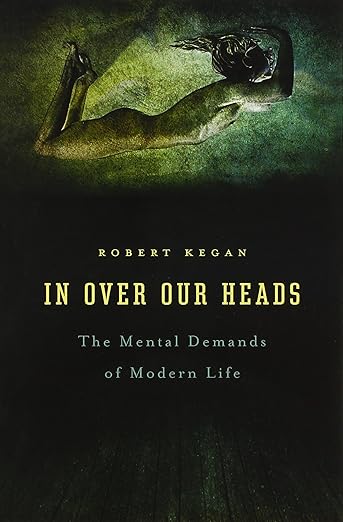
The book
In Over Our Heads
Robert Kegan
If contemporary culture were a school, would anyone graduate? Kegan applies his theory of adult development to the demands of modern life — as parents, partners, employees, and citizens — and reveals the mismatch between what these roles require and where most adults actually are developmentally. The most accessible entry into Kegan's framework for general readers.
Buy on Amazon →Go deeper
Programs grounded in adult development theory
Introduction to Adult Development Theory
A deep grounding in CDT for practitioners — the stages, how to recognize them, and what they mean for coaches and leaders.
SOI Training
Learn to administer and interpret the Subject-Object Interview — the developmental assessment tool that directly measures stage.