Our Thinking
Immunity to Change™
Why do smart, motivated people fail to make changes they most want to make — and what can actually be done about it?
Why does motivation alone so rarely produce the change we're after?
A landmark medical study found that when doctors tell heart patients they will die if they don't change their habits, only one in seven will be able to follow through successfully. This isn't a story about weak motivation — these are people who have been told their lives depend on it.
Robert Kegan and Lisa Lahey's insight is that this kind of failure is not a deficit — it is a success. The failure to enact a visible commitment is often due to the success of enacting an invisible one. The patient isn't failing at taking their medication. They are succeeding at protecting something they haven't yet been able to name — perhaps a self-image as someone who isn't chronically ill, or a sense of autonomy that a permanent prescription seems to threaten.
They called this structure an immunity to change. One foot is on the gas — the sincere commitment to the visible goal. The other foot is on the brakes — a hidden competing commitment that the goal-defeating behaviors are serving. Until you can see both feet, you cannot move.
“The failure to enact our visible commitments is often due to the success of enacting our invisible ones.”
Robert Kegan & Lisa Laskow Lahey
The tool
The Immunity to Change™ Map
The ITC Map is a structured diagnostic — a four-column process that walks you through the full architecture of your immune system. Each column builds on the last. By Column 4, you can see, perhaps for the first time, the assumption that has been running the whole system — and begin to test whether it still needs to.
1
Improvement goal
What you most want to change — a real, meaningful commitment, not a vague aspiration. The starting point is always something the person cares deeply about and has been unable to accomplish.
2
Doing / not doing
The behaviors that work against that goal. Not failures of will — a scrupulously honest inventory of what you actually do and don't do that undermines your stated commitment.
3
Competing commitments
The hidden goals those behaviors serve. Behind every self-defeating behavior is a protective logic. Something is being kept safe. Column 3 makes that protection visible for the first time.
4
Big assumptions
The deeply held beliefs that make the competing commitments feel necessary. These are not consciously chosen — they are the invisible rules of the world as experienced. Column 4 is where genuine change becomes possible.
Why it works
What creates the conditions for lasting change?
Most approaches to change work on the behavioral level — they try to replace bad habits with good ones. The ITC process works at the level of meaning-making: it asks not what you need to do differently, but what you are currently protecting, and whether that protection is still necessary.
What makes big assumptions so hard to examine is that we don't have them — they have us. They are not beliefs we hold; they are the lens through which we see. The ITC process creates the conditions for moving assumptions from subject to object: from something you are, to something you can examine and test.
That shift — small, specific, tested — is what genuine adaptive change looks like. It doesn't happen through insight alone. It happens through a series of careful experiments that let people discover whether the assumption they've been living by still holds.
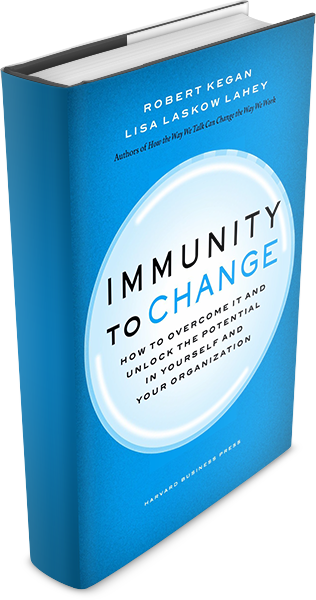
The book
Immunity to Change™
Robert Kegan and Lisa Laskow Lahey
The foundational text. Kegan and Lahey present the full theory alongside hands-on diagnostics and case studies — showing how the hidden competing commitments that block change can be surfaced, examined, and worked with. The book that made this method available to practitioners worldwide.
Buy on Amazon →Work with this method
Programs that put the ITC process into practice
Introductory programs
The Change Course
Experience the ITC process yourself — a six-week guided journey through your own immunity map.
Immunity to Change: Foundations to Application
Learn to guide individuals and groups through the ITC process. The entry point for coaches and practitioners new to the method.
Application Workshops
One-day intensives in applying ITC in your specific practice context — groups, one-on-one coaching, or teams.
ITC with Teams
Lead entire teams through a collective immunity map — understanding the shared assumptions that block a group's most important work.
Advanced certification
Coach Certification Program
The only path to full ITC coach certification — a selective, 12-month program for practitioners ready to master the method and join the faculty network.